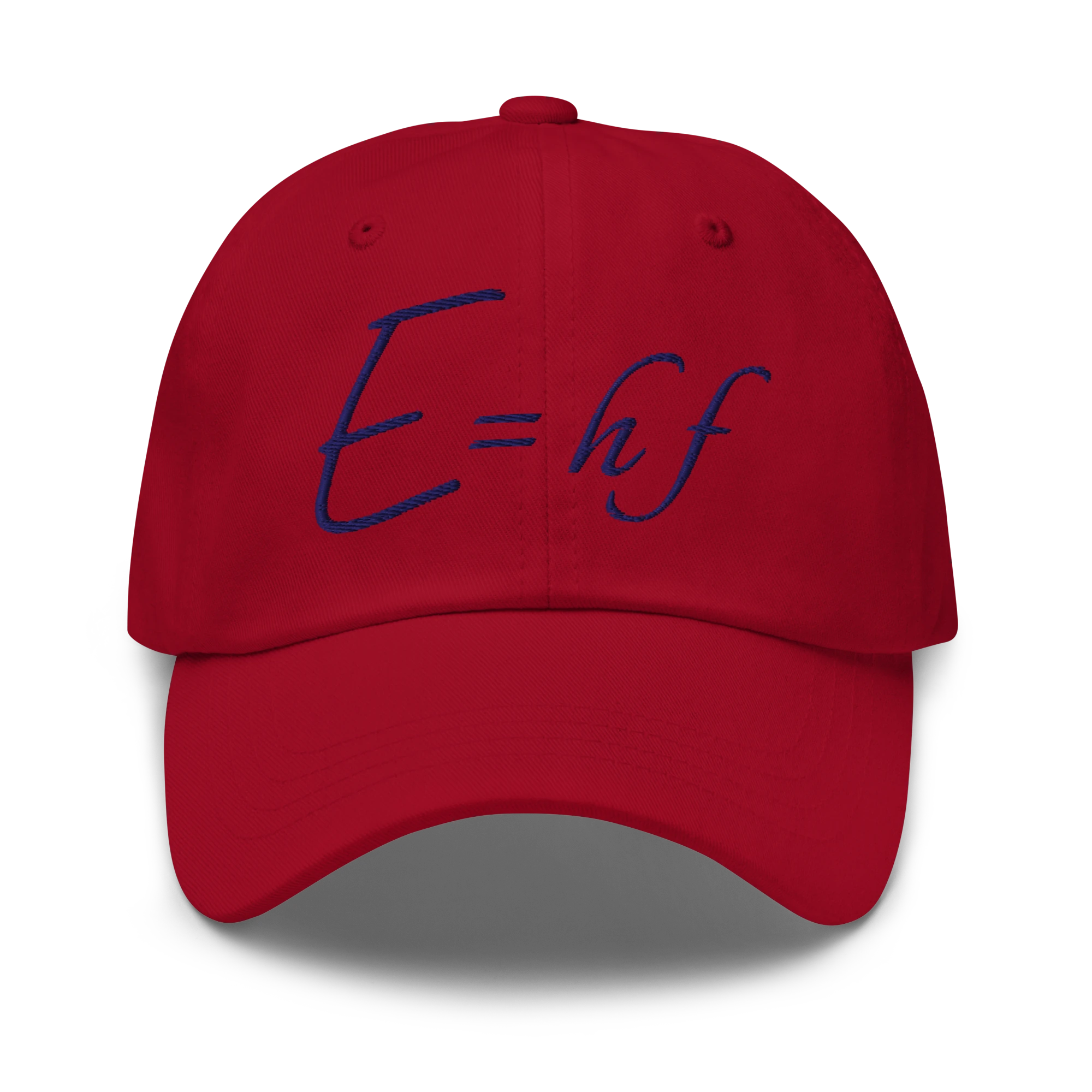

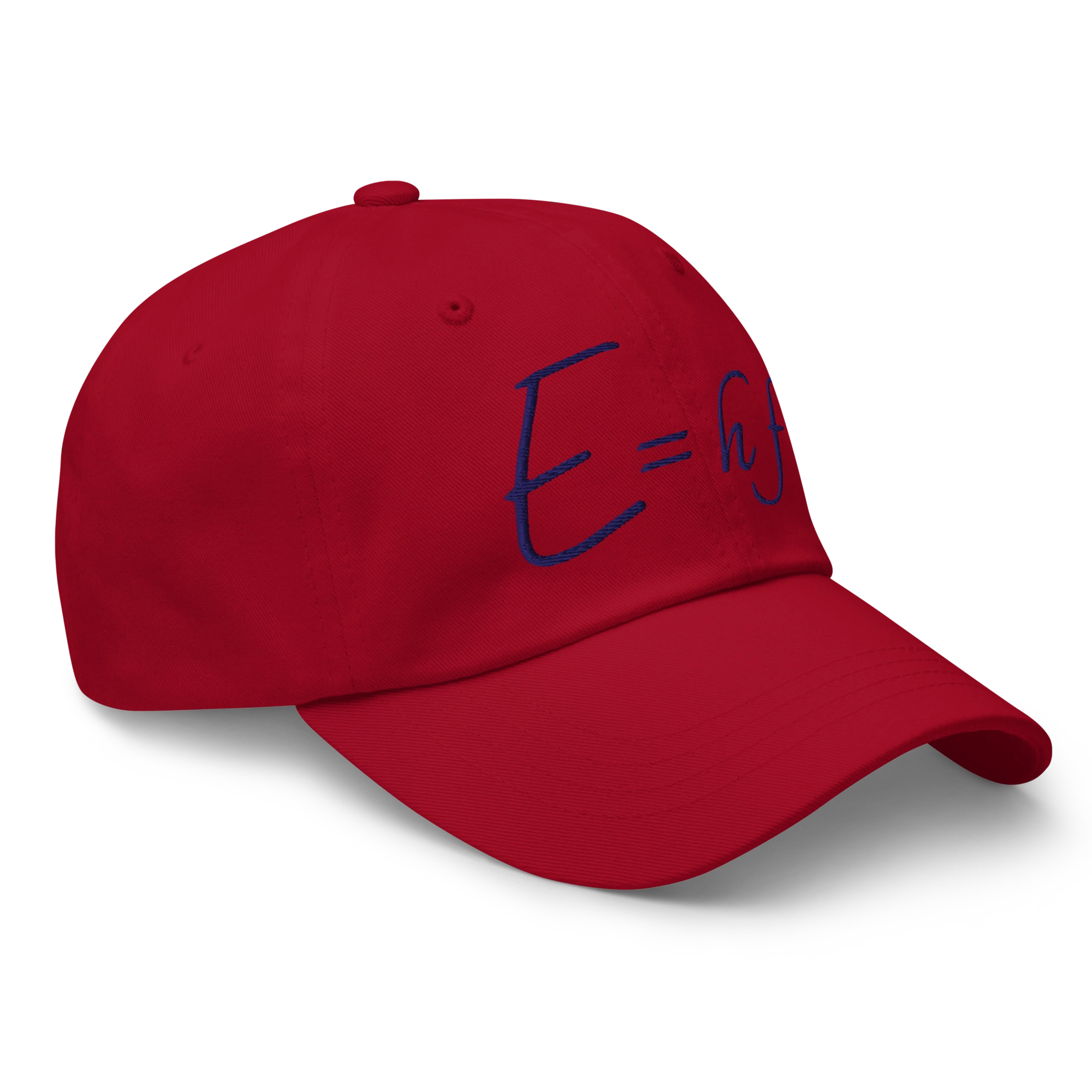
The relation
The relationship is
where E is photon energy, f is frequency, and h is Planck’s constant. Physics texts also commonly write the frequency as the Greek letter ν (nu), giving the equivalent form E = hν. In the SI, h is defined exactly as 6.626 070 15 × 10−34 joule-second. Higher-frequency photons therefore carry more energy per photon than lower-frequency photons.
Planck, Einstein, and the historical nuance
Max Planck introduced the constant while solving the blackbody-radiation problem around 1900, quantizing the energy exchanged by oscillators. Albert Einstein’s 1905 explanation of the photoelectric effect pushed the quantum idea further by treating light energy itself as arriving in discrete quanta related to frequency. Modern photon language therefore carries both Planck’s and Einstein’s contributions.
Why h matters
Planck’s constant is tiny on everyday scales, which is one reason quantum behavior is not obvious in baseballs and coffee mugs. At atomic and subatomic scales, however, h sets the characteristic scale at which classical intuition gives way to quantum mechanics. The reduced constant ħ = h/2π appears throughout the formal theory.
Why wear it?
Because E = hf is a compact gateway into quantum physics. It points toward photons, spectroscopy, lasers, semiconductors, the photoelectric effect, and the strange fact that nature’s microscopic bookkeeping is quantized. Three symbols, one equals sign, a very large story.
Wear what you know.
You are not wearing a random graphic. You are wearing something you know, understand, believe, study, build, play, or find worth thinking about. That is the idea behind every NerdWear Expression.